
It s a shame I've been sitting on this book for about two years now. A friend of mine gave me Never Eat Alone , by Keith Ferrazzi a couple years ago (thanks Rey), and it s been on my bookcase ever since. It was resting there not because I didn't want to read it, but because I already had so many others in the pipeline. I finally got around to reading it last month and I definitely recommend it. In very simple terms, Ferrazzi explains why networking is important and how to do it. From how to make call lists to planning dinners to personal branding to goal setting, it s all here. He also maintains a valuable blog .
Inevitably there will be times when you have setbacks or things don t go your way. Maybe you didn't get a job you thought you were sure to get. Maybe you lost a job unexpectedly, didn't win a contract, or lost a major client. Your car always seems to break down right after you've had some other unexpected expense. These kinds of situations immediately place us in crisis. They don t feel good, but sometimes they re what we need in order to grow. The beautiful thing about crises is that they force us to take a step back and reevaluate what s going on in our lives and rediscover what we truly want and need. When we get over that initial shock and feeling of disappointment, we might realize that maybe that job wasn't really the best for us anyway. Maybe, just maybe, that wasn't what you really wanted to spend your life doing. Maybe that friend was holding you back instead of pushing you forward. The way I deal with crises of these sorts is simple: If something doesn't go my way professionally, I try to create a situation that would be more rewarding than the situation originally planned. A while ago, I was offered a job that looked very promising. After I accepted the offer, they pushed the start date back three times, later informing me (via e-mail) that they wanted to bring me on in the near future but I should feel free to explore other options. I was extremely disappointed. I felt disrespected and angry, but decided to make the best of the situation and follow my dream of working internationally. I then flew to Santiago, Chile and had great professional and personal experiences I wouldn't have had otherwise. Later, reflecting back on the original opportunity, I realized that working for a company that avoids a start date three times and then can t pick up the phone to explain the situation is probably not where I need to spend my time. Use setbacks as an opportunity to put your goals in order and act on them. In the moment, it s difficult to look at a setback as temporary, but they are. They happen to everybody. It s how you respond to them that will determine how they affect you.
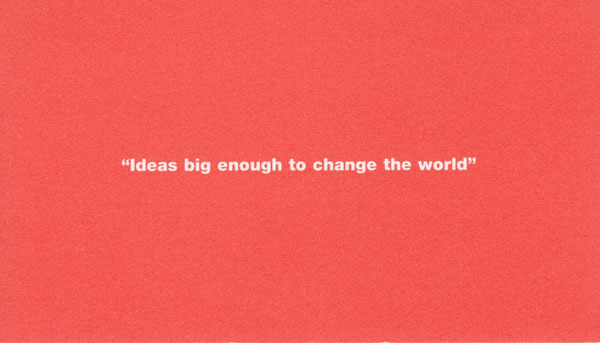
Last night I attented the TEDxSanAntonio mixer and was fortunate enough to meet George Riley (@griley), one of the people that makes the official TED happen. At the end of the evening, he passed me his business card. This is the back of that card. If only more businesses had taglines like this. If only more businesses lived this type of philosophy. If only more businesses operated like this. Think of what we could accomplish together.
Other people I lucky to see again included:
@doingmedia
@TEDxSanAntonio
@writeontime
@kitestringbyday
@julianaperez
@benyc440

According to the book Kingdomality by Sheldon Bowles, Richard Silvano, and Susan Silvano, the personality type that best describes me is Discoverer. For those of you who know me, what do you think? Does the description below describe me?
Many years ago there was a period of time that is often casually called “Medieval.” It was a time, so the story tellers tell us, of tiny kingdoms, brave knights and ferocious dragons.
Transportation and travel were both crude and difficult, usually necessitating that each kingdom be as self sufficient and self reliant as possible. So it was very important that within each kingdom all the major crafts and professions of the day were ably represented to insure the survival of the kingdom. In the English language we still see remnants of some occupations in the familiar surnames such as Smith, Carpenter, Miller and Baker to name just a few.
Interestingly enough, beyond the specific title the vocation also took on its own greater personality. This personality preference can also give a broader understanding of the basic complementary style and types necessary to the kingdom’s survival, or perhaps any organization’s success. Although the specific vocation influenced the name, it was no accident that certain personality types and styles gravitated to certain occupations. The personality of these jobs suited the inclinations of the job holders, and the predecessor to modern day job descriptions was born. The successful matching of a job-holder’s personality to the personality and unique requirements of the job was necessary to the kingdom’s survival, or perhaps any organization’s success. The successful kingdoms more than likely were able to blend the differences into a powerful and formidable entity. With today’s diverse workforce, the corporate kingdom that acknowledges and nurtures these personality preferences could become an organization as successful as the Camelot of old.
Even though we now appear to have the freedom to explore many different career alternatives, we still have a medieval vocational personality within each of us. This personality, properly identified and understood, can motivate our success but, if ignored, may set the stage for our ultimate failure. Since times appeared to be simpler then, let us return to the kingdoms of medieval Europe and see what we would have done then, regardless of what our names are now.
Your distinct personality, The Discoverer, might be found in most of the thriving kingdoms of the time. Your overriding goal is to go where no one else has ever gone before. Regardless of the number of available natural problems to be solved, it is not unusual for you to continually challenge yourself with new situations or obstacles that you have created. You are an insatiable explorer of people, places, things and ideas. You thrive on constant change and anything new or different. On the positive side, you can be creatively rational as well as open minded and just. On the negative side, you might be an impractical and indecisive procrastinator. Interestingly, your preference is just as applicable in today’s corporate kingdoms.