
Inevitably there will be times when you have setbacks or things don t go your way. Maybe you didn't get a job you thought you were sure to get. Maybe you lost a job unexpectedly, didn't win a contract, or lost a major client. Your car always seems to break down right after you've had some other unexpected expense. These kinds of situations immediately place us in crisis. They don t feel good, but sometimes they re what we need in order to grow. The beautiful thing about crises is that they force us to take a step back and reevaluate what s going on in our lives and rediscover what we truly want and need. When we get over that initial shock and feeling of disappointment, we might realize that maybe that job wasn't really the best for us anyway. Maybe, just maybe, that wasn't what you really wanted to spend your life doing. Maybe that friend was holding you back instead of pushing you forward. The way I deal with crises of these sorts is simple: If something doesn't go my way professionally, I try to create a situation that would be more rewarding than the situation originally planned. A while ago, I was offered a job that looked very promising. After I accepted the offer, they pushed the start date back three times, later informing me (via e-mail) that they wanted to bring me on in the near future but I should feel free to explore other options. I was extremely disappointed. I felt disrespected and angry, but decided to make the best of the situation and follow my dream of working internationally. I then flew to Santiago, Chile and had great professional and personal experiences I wouldn't have had otherwise. Later, reflecting back on the original opportunity, I realized that working for a company that avoids a start date three times and then can t pick up the phone to explain the situation is probably not where I need to spend my time. Use setbacks as an opportunity to put your goals in order and act on them. In the moment, it s difficult to look at a setback as temporary, but they are. They happen to everybody. It s how you respond to them that will determine how they affect you.
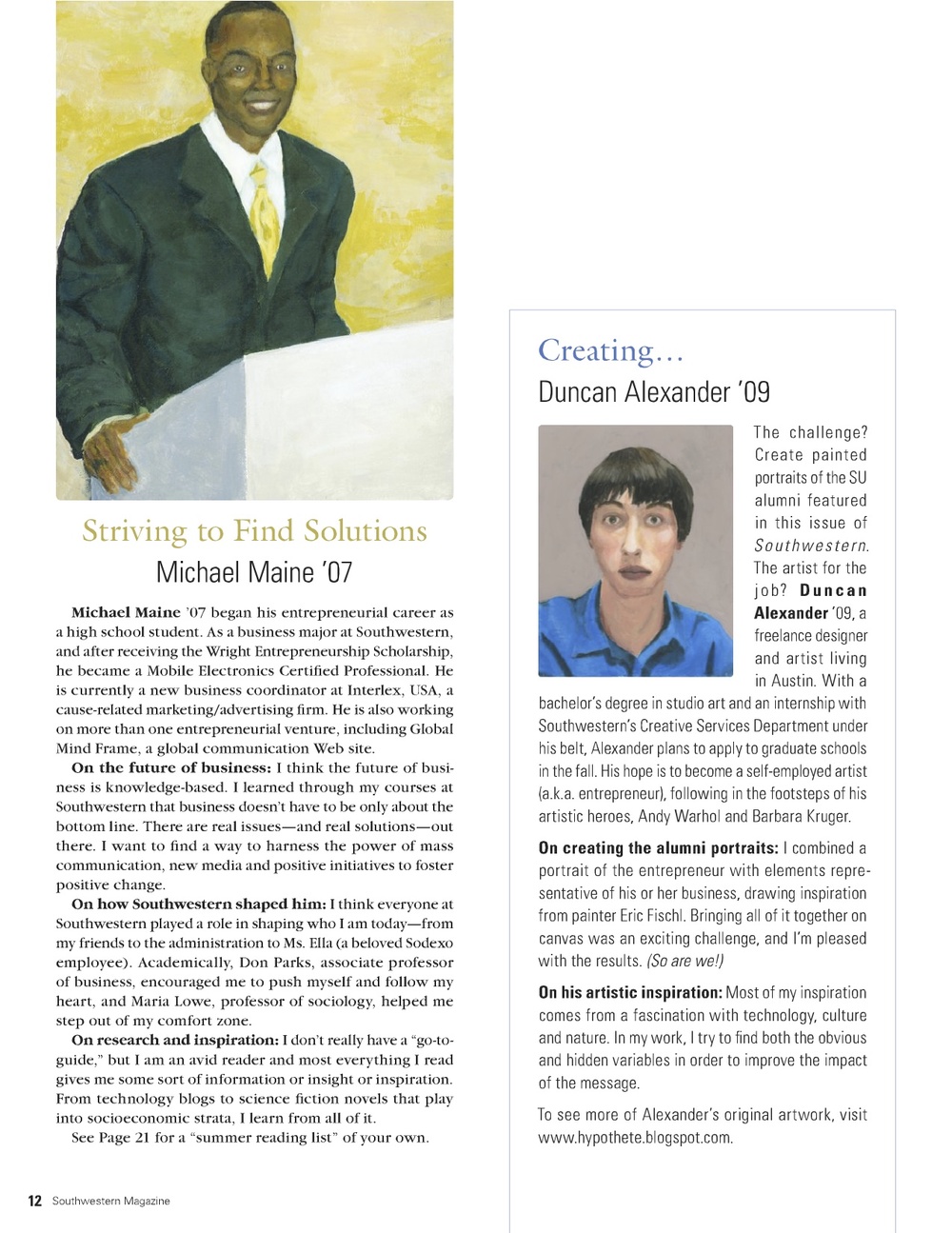
It’s not everyday I get an article written about me, so I thought I’d share this with you today. I didn’t even know it was written until I got a text message from my friend Dylan saying, “Hey man how’ve you been? Saw your picture in the new SU mag. Gmf still goin’ well?” (Thanks for letting me know man). The “GMF” that he is referring to is Global Mind Frame, a project that I’ve been working on for a few years to try to promote global collaboration and learning. Still working on it. If you know any developers who would be willing to work with me on this project, please feel free to let them know that I would love some help. To read the entire magazine, follow this link.
Credits:
- Artwork: Duncan Alexander
- Interview: Kristina Moore

Putting a deadline on a dream is one of the most critical things you can do to prepare yourself for success. Dreaming is meaningless without putting a plan in place to convert that dream to a reality. Oftentimes the difference between somebody who accomplishes their dreams and somebody who doesn’t is the determination and action to make it happen. You can dream all you want, but it’s the action you put into place that will get you there.
Write It Down
Turn a dream into a mission by writing it down, committing you to it. Be specific with your goal. Where specifically do you want to be in three years? I don’t like 10-year plans unless you have other milestones in between them. Ten years is often too far into the future. After you write it down, place copies of your commitment where you will often see it (your refrigerator, wallet, desk, bathroom mirror, etc.). Also, tell people. Not only will they help you stay committed, you never know who might be able to help you accomplish your mission.
Develop an Action Plan
Without an action your dream will remain just that – a dream. After you write your goal down, put a plan in place to reach it. What specific steps will it take to accomplish your goal? What skills will you need? Who will you need to know? Map out a course that will take you to your destination and stick with it.
Put it Into Action
Once you have a plan, act on it. Begin by getting in contact with those who can mentor and help you on your journey. Research the organizations you will need to know. Gain (or hone) the skills you will need. Get out there and do it.

The “golden rule,” while often taught as the ideal way to treat others, does not take into account different personalities, cultures, and backgrounds. Doing unto others as you would have others do unto you only work when people are like-minded. This may work when you share similar surroundings, teachings, and values. However, as technology, education, and work allows us to become more interconnected with people across the city, state, nation, and world, it’s important to realize that not everybody wants the same treatment.
We need to move beyond the golden rule to something higher (maybe the platinum rule?) and do unto others as they would have you do unto them. I don’t want to be treated the way you want to be treated. I want to be treated the way I want to be treated.