
There's no difference between a pessimist who says, "Oh, it's hopeless, so don't bother doing anything, " and an optimist who says, "Don't bother owing anything, it's going to turn out fine anyway." Either way, nothing happens. - Yvon Chouinard, founder of Patagonia
Check out this informative blog post written by friend and colleague Jake Negovan. Here's an excerpt:
Net neutrality is the philosophy that all internet content is treated equally by internet service providers. That philosophy means that if you build a website and I want to visit it, I can get to your website just as easily as I could get to pages created by Matt Drudge, Perez Hilton, or Harry Knowles. It means that if I want to read about new cars and their safety ratings, I have equal access to General Motors, Consumer Reports, or Ralph Nader. It means that a handful of people in San Antonio can create a web outlet for multi-cultural commentary on politics and culture, name it RedBrownandBlue.com, and nothing stops those people from being read across the entire United States.
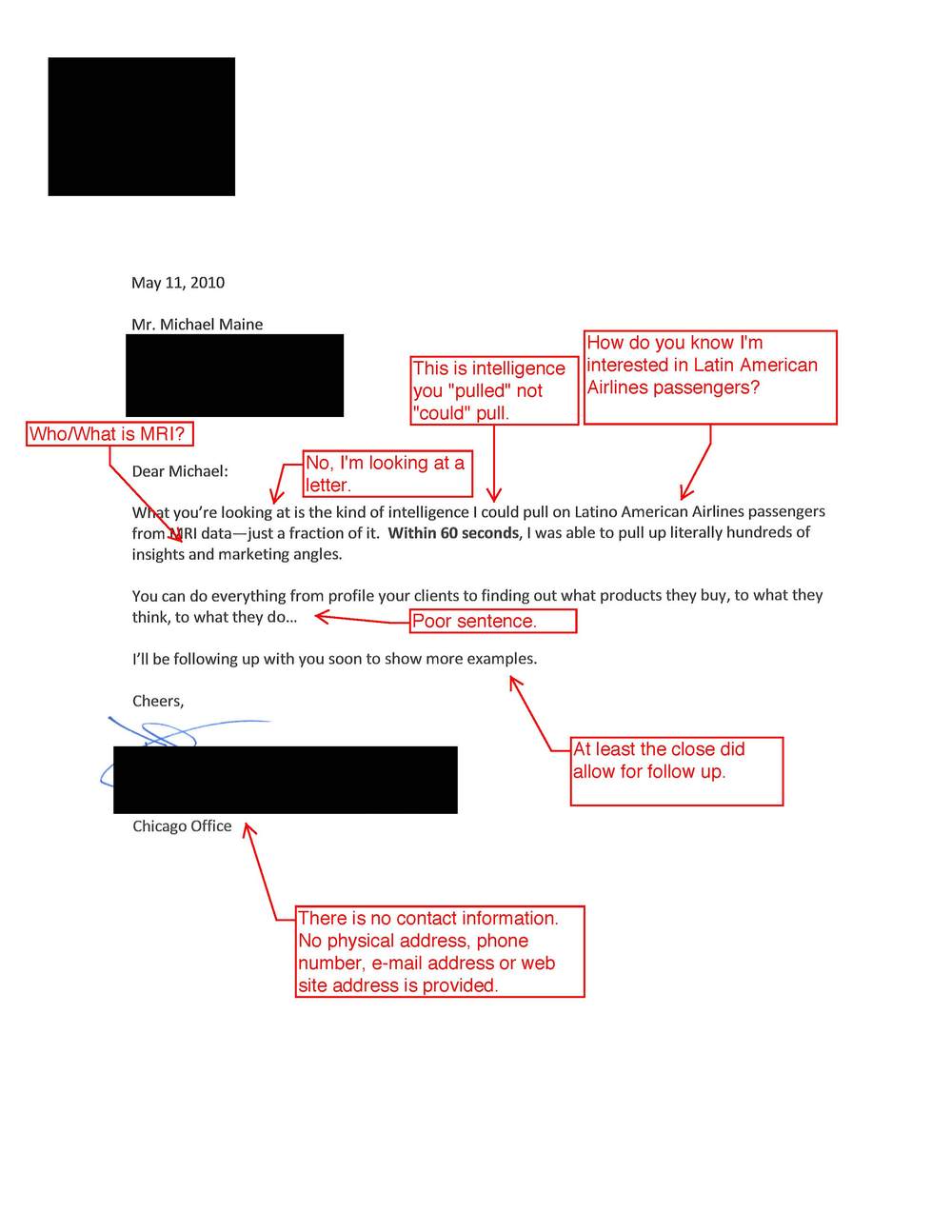
Below is an unsolicited sales letter I received at the office a few weeks ago from a company who sells market research. We already have sources for our syndicated research here, but I took a moment to check out what they have to offer. Unfortunately, both the letter and the offering were underwhelming. I've removed the name and company, but here is a good example of what not to do in a sales letter, especially when it's unsolicited.
When writing a persuasive letter, follow the persuasive paradigm and include the following:
- Problem Statement
- Benefits of Solving The Problem
- The Solution
- Strong Conclusion
None of these is present here.


Today I was reading FML when I came across this post:
Today, I was turned down for a job as a cashier at Best Buy. I worked like hell to get into and then graduate from one of the top Telecommunication schools in the country. I spent all my time with extracurriculars to help my resume instead of partying like my friends. I can’t even be a cashier. FML.
Finding a job, especially right now, can be difficult. Sometimes it seems like you’ve done everything right, but still can’t get things to fall in your favor. There are jobs out there, and you can have the best credentials in the world, but if the people doing the hiring don’t know about you or your credentials, you won’t get the job.
Today’s job market is extremely competitive and differentiation is key to landing and keeping your job. Starting next Monday, I will publish a 5-day “minicamp” on using social media to find a job, network, and advance your career. In the meantime, here’s a homework assignment for the weekend.
Resume
Your resume, while becoming a dated method of screening, is still heavily used in the hiring process. Remember, recruiters are getting several resumes a day and only spend about fifteen seconds with each one, so you need it to be as effective as possible:
- Proof read for ALL errors and typos.
- Have somebody else critique it. An HR person would be ideal.
- Use keywords in your resume to make it searchable in databases, but don’t overdo it or use them for the sake of using them.
- Don’t just list what you’ve done. Make your experience relevant to what you can do for the prospective company.
- Please, please, please make sure you include a valid phone number and email address. There are several cases when the employer wanted to hire a candidate but couldn’t reach them to offer the job.
- Proof read for ALL errors and typos…again.
Cover Letter
I know it sounds tedious, but each cover letter should be tailored to the particular employer (not industry) for which you want to work. Here’s a list of questions to answer in your cover letter:
- Why do I want for this company?
- What skills are necessary for this job?
- Do I have these skills? If so, how can I demonstrate them?
- What unique qualities to I bring to the table?
- What makes me the ONLY qualified candidate?
References
Although not always required, a list of professional references can help set you apart from other applicants. Take the time to build a list of 4-6 people (ask for the permission first) and create a center-aligned document that shows: Company Name, Person Name, Phone Number, Email Address, Years Known.
Network
I can’t stress this enough. Take a while (an hour, two hours, however long it takes) to map out your network. Look at family, friends, friends of friends, teachers, coaches, neighbors, anybody with whom you have a positive rapport and ask around for any potential leads. By the way, you should be networking all the time, not only when you are looking for a job.
Online
If you haven’t already done so, purchase your name as a domain name. Some of the popular places to purchase a name are GoDaddy, HostMonster, and Nettica. If your name is already taken, try using adding a middle initial or name. I wanted michaelmaine.com, but that was already taken, so I added my middle initial to get michaelbmaine.com. Maybe one day, the other one will become available and I’ll have both pointed to the same place. Having your own domain name will help when people search for you during the job hunt. Also it will create a space where you can control your image. I’ll give more details next week.
Those are the basics. I hope this gives you something to get you started. Check back on Monday when I start covering how to use various social media maximize your job search efficiency. Please subscribe to this blog or pass it along to anybody you think might benefit from the help. Also, if you have any other tips, comments are always welcomed. Until next time…peace.
Job Hunting Series
- Introduction
- Day 1 - Intro To E-branding
- Day 2 - Maximize your network
- Day 3 - Facebook, LinkedIn, and YouTube
- Day 4 - Final tips
- Day 5 - Interview w/ Alex Anderson