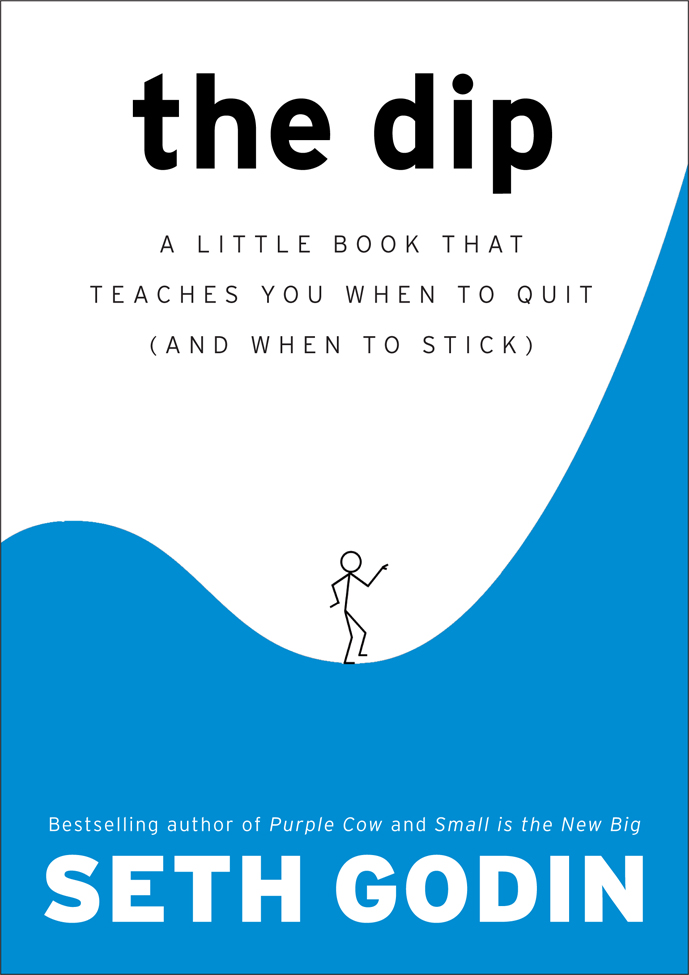
Book Review - The Dip

The Dip is an excellent book that can benefit just about anybody. Marketing guru, Seth Godin immediately sets the agenda, stating that this is a book that teaches you when to quit and when to stick. Just eighty pages later, the book is over—leaving you with a totally new perspective on how to tackle your job, career, relationships, and life. “How can 80 pages have such an impact on your life?” you might be asking yourself. Well, put simply, in those eighty pages, Godin describes how to evaluate your situation by objective means. For example, if a job will not provide the opportunity for you to grow in the direction you want to go, then you need not waste the time to become good at something that will not pay reward in the future. Likewise, if you do not have the drive to want to be the best at something, then most likely, it is not something that you should be doing in the first place.

While I think this is a book that everybody should read, I do not completely agree with the entire sentiment. I feel that every experience, whether it be good or bad, is an experience that can prove beneficial in the long run. I think it would be fair to say that all of us have done something that we found little enjoyment from, if any, yet have had some kind of positive impact in our lives. Maybe we’re stronger for it. Maybe we learned something. I recently left a job where I received little if any satisfaction. The work was extremely repetitive, the compensation was not the greatest, and there was little to no room to develop the professional skills required for my desired career path.  I did quit, as I realized that the more time I spent at the job the longer I was putting off doing something that would be more closely related to my desired career path, as well as professional and personal development.  At the same time though, I developed skills in the arena of personal finance, relationships with some great people, and an appreciation for people who devote so much time serving the needs of others.  The job was not for me, and would not take me where I wanted to go, but added to my life an experience that I gained from.

The book probably shouldn’t be read too literally, but is definitely worth the read. It is enjoyable, gives insight, and provides a way to develop another perspective about what is going on in your life.

Bibliographic Information:

Godin, S. (2007). The Tip: A Little Book That Teaches You When To Quit (And When To Stick)

Book Review - Coolhunting

Coolhunting describes and illustrates, in detail, the benefits of collaborative innovative networks, or “COINS”. The straight forward approach that authors Scott Cooper and Peter Gloor employ with simple diction and real world examples of COINS engages both the casual audience as well as those who are deeply intrigued with the idea of tapping into the power of collective thinking and brainstorming. I personally found this book to be enlightening and beneficial as I continue my research and case studies of various businesses.

Communication is one of the most difficult barriers for a company to overcome when conducting business on a global scale. Differences in language, culture, business practices, geography, logistics, and many more factors greatly impact the efficiency, productivity, public image, and morale of a company. The use of collaborative networks is not only beneficial, but is often a core competency of these companies. Major innovative companies such as 3M, Google, and Procter and Gamble not only make tremendous use of COINS but also build the use of these networks into respectable business models. The benefits of these networks has been known for some time among certain groups, but with the monumental paradigm shift in web communication from basic static pages to web 2.0, collaborative networks are now more widely accessible and taken advantage of by a much greater number of people within the context of forums, blogs, research, and profiles on social networking sites.

Personally, I took much interest in this book. I believe that collective thinking can prove very beneficial when analyzing issues and making progress in many different types of projects. For example, I considered the number of research papers and projects that are performed from grade school through postgraduate work. The vast majority of the findings from this research is typically shared between only a few people, either the teacher/professor, or with the classroom. Very rarely, is the research shared in the context of a forum, convention, or with others studying the same topics. Granted, not every research paper warrants being shared, and there are research methods and guidelines that should be respected and followed, there still remains a great amount of data that, once uncovered, becomes stale. There might be several others who have found similar findings, or would like to share their findings, opinions, or ideas with other people sharing a common interest. This is where the power of a COIN can reach its potential. What if people from around the school, city, state, country, or world could collaborate with each other and each make a contribution to the purpose? The efficiency and wealth of knowledge would be absolutely monumental. Much of the weakness that is involved with traditional research is the bias of the individual researcher. Along with any findings that a researcher uncovers, is the perspective that a geographical, socio-economical, and cultural background provides. In COINS we are actually able to help mitigate those biases by analyzing the data from various perspectives, allowing the objective of the research or project to remain in clearer focus.

In short, reading this book really opened my eyes to the power of utilizing networks in general. When those networks are focused, the results can be huge. Going forward in my projects and research the use of collaborative networks will play a vital position in what I do, so as to allow much broader analysis and more specific solutions to be made. I definitely recommend this book to anybody who likes to work with people, are looking for ways to take their research or business to the next level, are interested in marketing, or are simply curious to know how this concept has been implemented in some of the most successful cases in history.

Bibliographic Information:
Cooper, S. M., & Gloor, P. A. (2007). Coolhunting: chasing down the next big thing. New York, New York, United States of America: AMACOM.

It's Official, I'm A Chilean Resident

It only took about 7 months, but I finally got my legal identification card for Chile. With a “carnet” anything is possible. That RUN number you see under my name is the tax identification number you need to get anything accomplished: Internet, cell phone, bank account, etc. I picked it up last Thursday. I know I don’t have a very long time to enjoy the doors that it opens now, but on the bright side, I have a souvenir I can keep in my pocket…

Sun Tzu on Simplicity-Complexity


There are not more than five primary colors (blue, yellow, red, white, and black), yet in combination they produce more hues than can ever be seen.

There are not more than five cardinal tastes (sour, acrid, salt, sweet, bitter), yet the combinations of them produce more flavors than can ever be tasted. -Sun Tzu